
How to Search St. Louis County Court Records
The official online entry point for most St. Louis County Court records is the Minnesota Court Records Online portal (MCRO). MCRO covers case search, hearing search, judgment search, and document search for St. Louis County District Court matters, and it is the first channel for records in civil, criminal, family, and probate categories. Public access data in MCRO reflects the Minnesota Rules of Public Access. Because the county has three District Court sites, results may not be synchronized across every courthouse record display, and some items are available only at the filing office.
For practical search work in St. Louis County, use MCRO first for speed, then use local courthouse channels for certified copies, missing documents, and non-displayed hearing or post-order details.
- Open MCRO Case Search and accept the portal terms.
- Choose a search mode: Name, Case Number, Citation Number, or Attorney.
- Limit by court to St. Louis County in the Court Locations chooser and apply one or more case categories.
- Review the case summary, parties, hearing events, and register of actions, then open the case for full filing context.
- If a case is not fully available online, contact the St. Louis County District Court administration for in-person inspection or certified filing requests.
Important workflow detail from St. Louis practice: MCRO is helpful but not complete. Street addresses and some comment fields are redacted, and pending criminal traffic matters without conviction can be omitted when searching by defendant name. In those cases, search by exact case number or citation instead. If the record is older, restricted, or sealed, local court staff will confirm the correct filing office and applicable inspection rule.
St. Louis County Court Structure
St. Louis County is served by the Minnesota District Court as its trial court. The county is part of the Sixth Judicial District with Carlton, Cook, Lake, and St. Louis. That means the same trial-level court handles civil disputes, criminal prosecutions, family matters, probate, and traffic-related district cases across all three county courthouses.
Above the trial court is the Minnesota Court of Appeals. Appeals from District Court decisions may proceed to the Court of Appeals, with limited further review by the Minnesota Supreme Court under appellate rules.
Case flow: District Court Records search › Lower Court Filing › Hearing Calendar and Order Updates › Appeal Path to Minnesota Court of Appeals
| Court | Jurisdiction | Case Types |
|---|---|---|
| Minnesota District Court | Primary trial court in Minnesota | Civil, Family, Probate, Criminal, Traffic |
| Minnesota Court of Appeals | Review of final and some interlocutory orders | Appeals from District Court decisions |
| Minnesota Supreme Court | Review of limited categories | Selected constitutional or substantial legal questions |
One practical reason this structure matters in St. Louis County is geography. The county is large, with Duluth in the south and multiple Iron Range communities in the north. The state court system therefore uses three full-service District Court locations rather than a single courthouse model.
St. Louis County Court Layout and Facilities
The St. Louis County District Court landing page confirms the countywide court footprint. Duluth, Hibbing, and Virginia each maintain a full-service court administration function with public access terminals for records. The layout is practical for a geographically large county where travel to a single downtown center would slow ordinary access.
Source link for the county court landing page:
https://mncourts.gov/find-courts/stlouis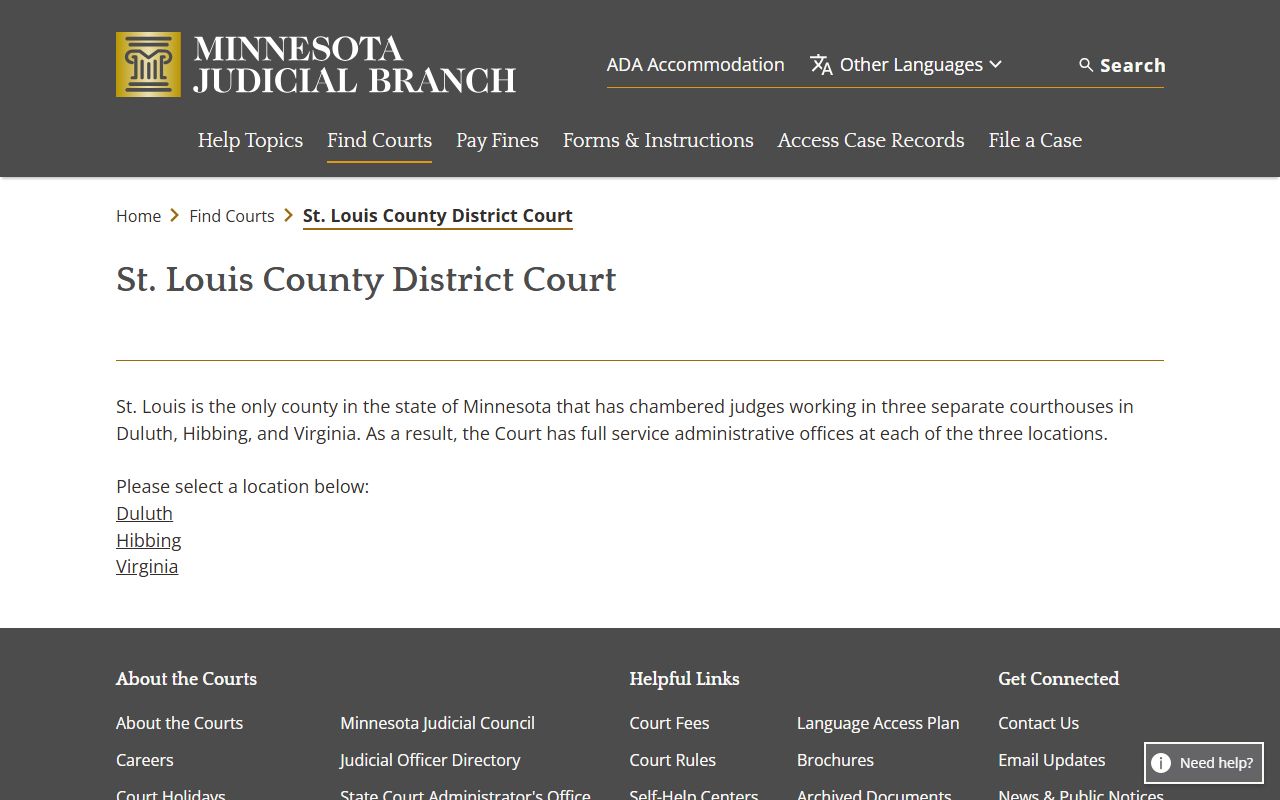
This landing page shows the countywide court structure and explains that trial matters are handled through three active courthouse service points in St. Louis County.
Source link for the sixth judicial district structure:
https://mncourts.gov/find-courts/sixth-judicial-district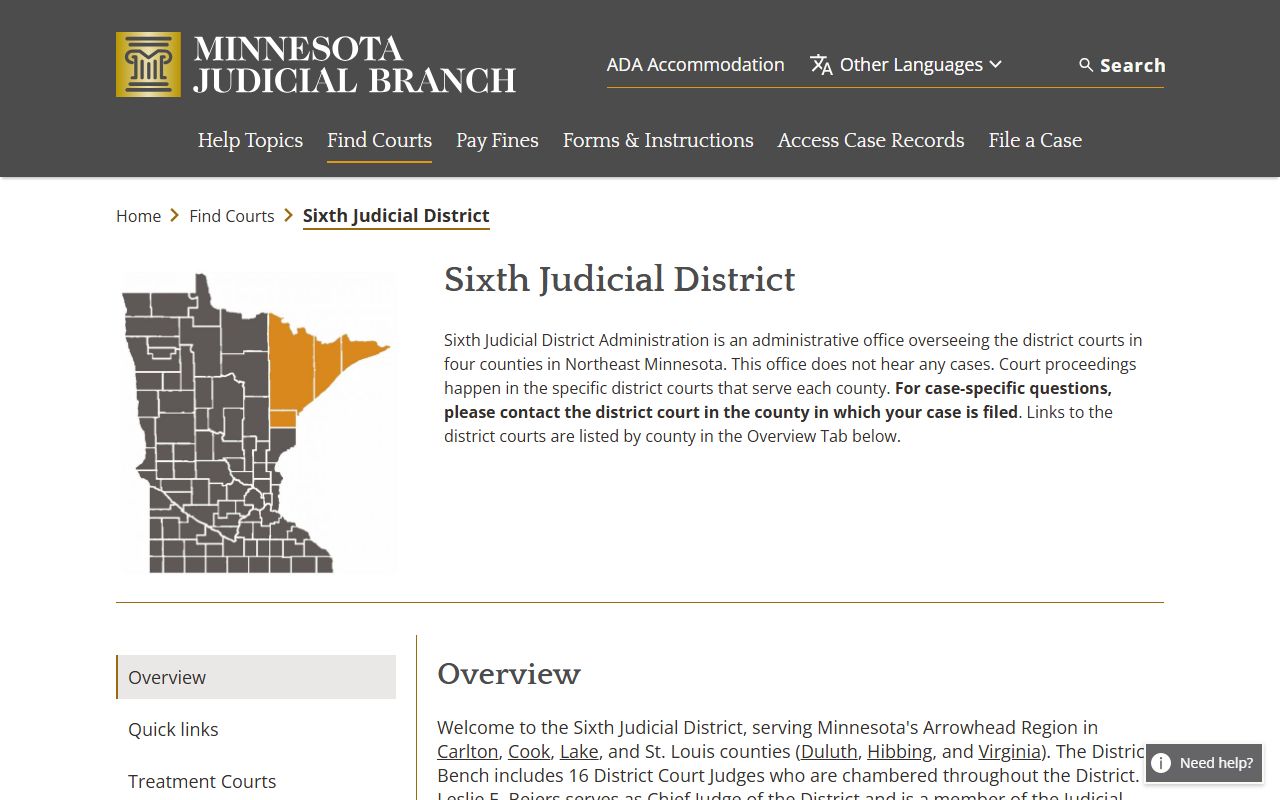
This overview ties St. Louis County District Court activity to district-wide jurisdiction and staffing context.
Source link for Duluth courthouse details:
https://mncourts.gov/find-courts/duluth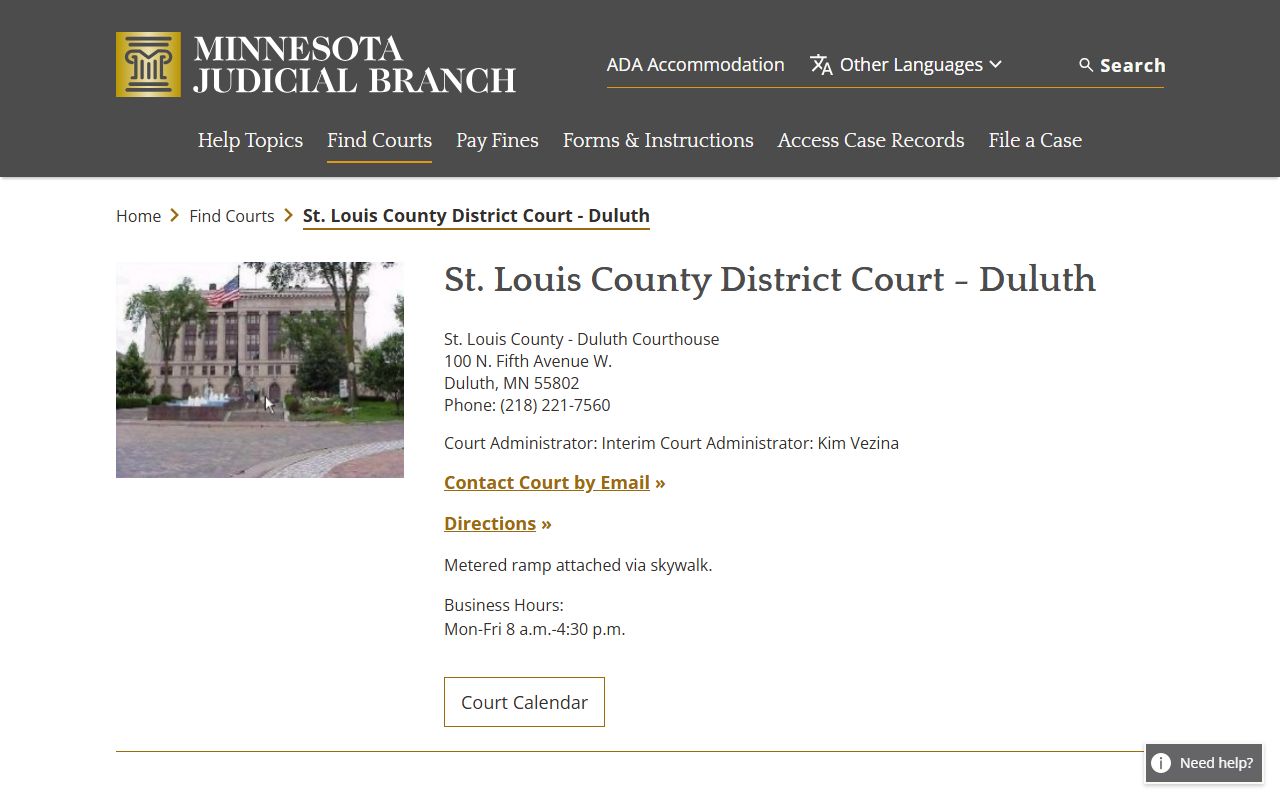
The Duluth court page confirms the main branch address, filing office context, and public access terminal availability for MCRO follow up and in-person review.
Source link for Hibbing courthouse details:
https://mncourts.gov/find-courts/hibbing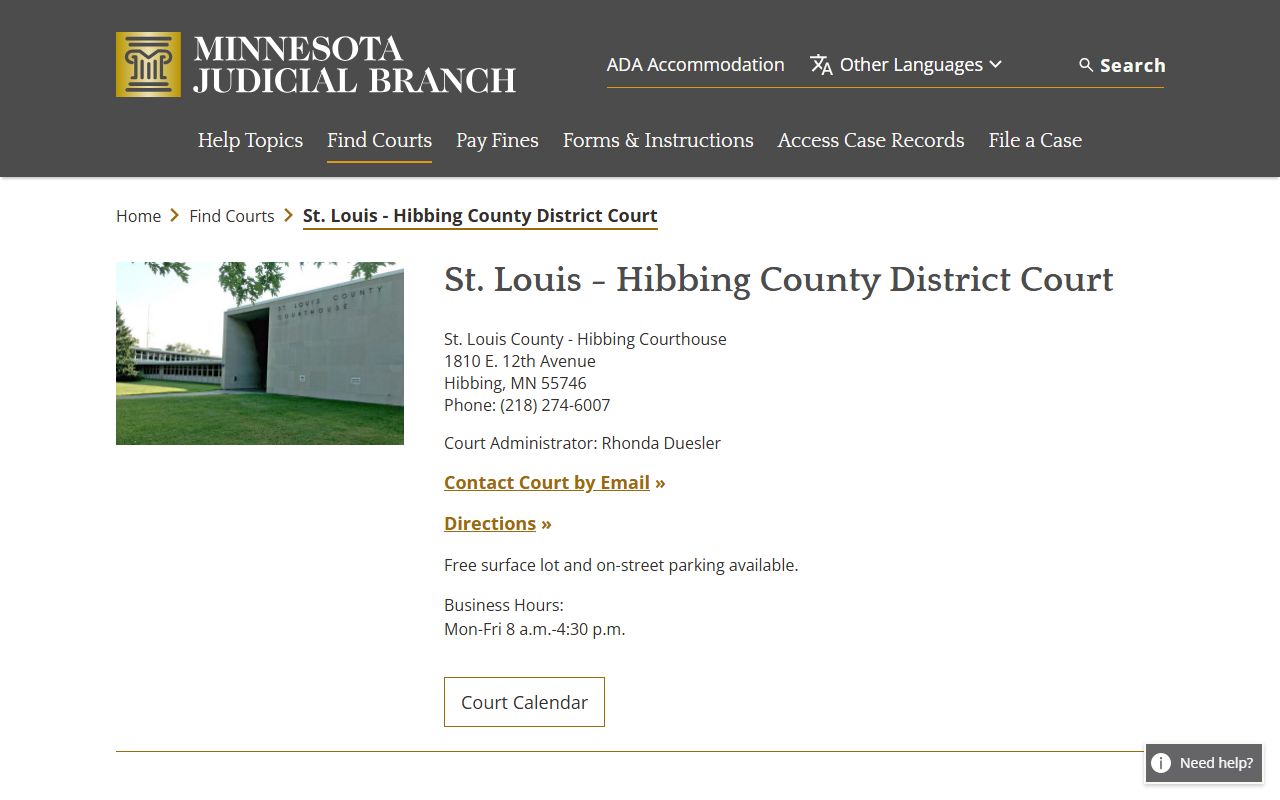
The Hibbing page provides the Iron Range branch location and access context for court users from northern communities.
Source link for Virginia courthouse details:
https://mncourts.gov/find-courts/virginia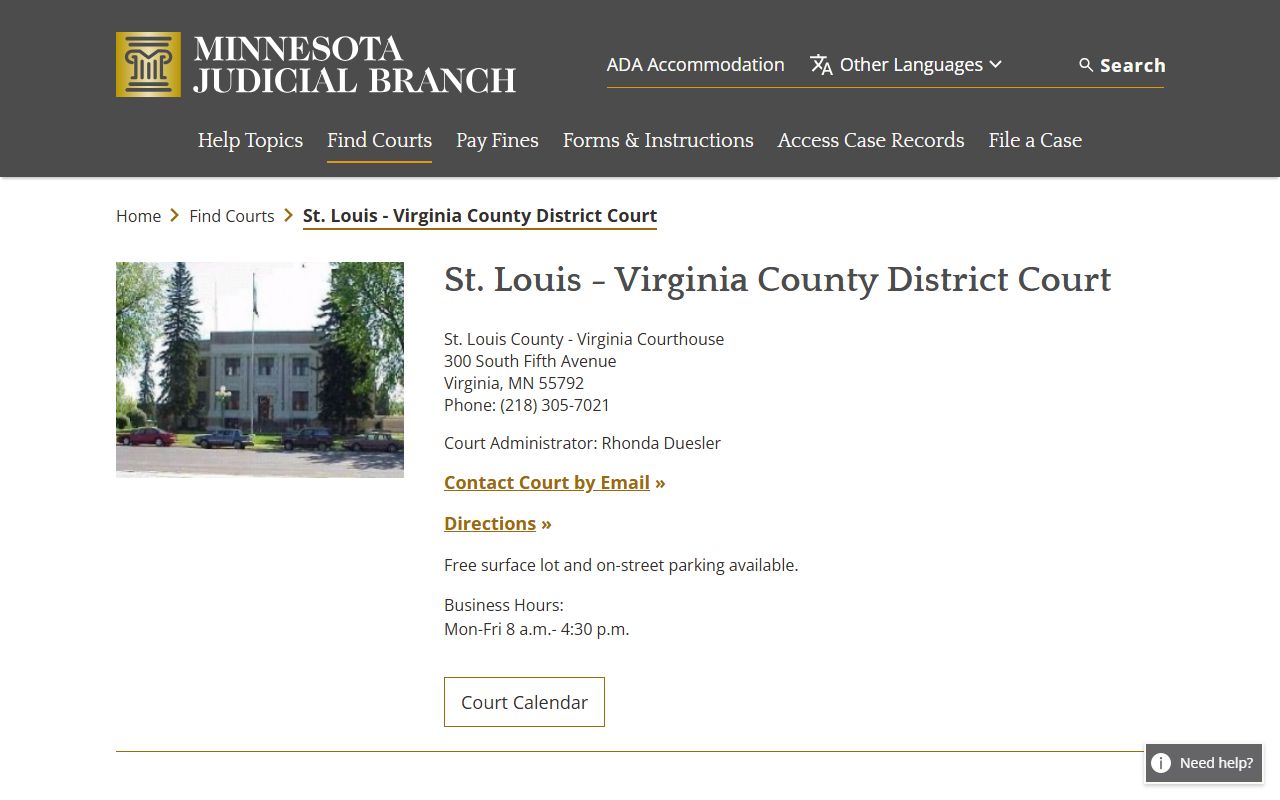
Virginia is the third full-service county location and includes details on parking and accessibility route options for local residents.
St. Louis County Courthouses
Each St. Louis County District Court office supports court filing, public records viewing terminals, and hearing calendars. Courts in Duluth, Hibbing, and Virginia remain coordinated by a single countywide trial-court system.
St. Louis County District Court - Duluth
100 N. Fifth Avenue W.
Duluth, MN 55802
(218) 221-7560
St. Louis County District Court - Hibbing
1810 E. 12th Avenue
Hibbing, MN 55746
(218) 274-6007
St. Louis County District Court - Virginia
300 South Fifth Avenue
Virginia, MN 55792
(218) 305-7021
Types of Records in St. Louis County Court
St. Louis County District Court serves all core civil and criminal pathways in its trial docket. Criminal records include complaint data, charges, hearings, disposition, and sentencing results. Civil records include disputes, judgments, and procedural motions. Family records include divorce, custody, child support, paternity, and parental orders where permitted. Probate and mental health-related records include estates, guardianships, and conservatorships when filed as trial-court matters.
Traffic and petty misdemeanor records are also trial court case files. Court records access is separate from criminal-history or jail-custody data, so use the correct channel when the question is about background information or sentencing status.
- Criminal records - Complaint, filing history, charges, hearings, disposition, and sentence entries for county criminal cases.
- Civil records - Lawsuits and orders in contract, landlord tenant, and financial enforcement matters.
- Family records - Divorce decrees, custody, parenting time, child support filings, and motion history.
- Probate records - Estate administration, guardianship, and conservatorship filings in the Probate Division of District Court.
- Traffic court records - Citation history, plea outcomes, fees, and hearing schedules.
What St. Louis County Court Records Show
A typical St. Louis County case record includes key identifiers and procedural milestones. The case number uses the Minnesota county/location format, for example 69DU-CR-25-809, which indicates county, case category, and filing year. You can expect case details like filing date, party list, court location, hearing list, and public documents where allowed under the Rules of Public Access.
| Field | What It Shows |
|---|---|
| Case Number | Trial docket identifier with county, category, and year. |
| Filing Date | When the court file was opened. |
| Case Category | Civil, criminal, family, probate, or mental health filing type. |
| Parties | Filing plaintiffs, defendants, debtors, criminal defendants, petitioners, and respondents. |
| Attorney | Counsel or legal representative listed with filings. |
| Hearing | Scheduled date, courtroom, and hearing type. |
| Judicial Officer | Judge or hearing officer assigned. |
| Register of Actions | Event log showing filing and action steps in sequence. |
| Dispositions | Outcome and case status updates when posted. |
Court Records, Criminal History, and Jail Data Are Not the Same
St. Louis County users should separate three channels: court case files, state criminal-history data, and jail custody rosters. Court records show what was filed and what happened as a legal process, while criminal-history sources are designed for background screening policy and are maintained by law-enforcement pathways.
The Minnesota BCA Criminal History Search is the correct general background route for criminal-history questions, while MCRO is the route for court case details. The jail roster is managed by the Sheriff Office and is updated regularly for present custody status. These systems can overlap in appearance, especially if a person is arrested on an active case.
For criminal-history context, Minnesota BCA is the primary public source:
https://chs.state.mn.us/
This supports a key workflow: when MCRO is used for court case history, separate custody verification usually requires another official channel.
Warrants and How to Clear Them
Active warrants in St. Louis County are published by the Sheriff as public assistance information, including felony and misdemeanor lists. The Sheriff does not issue warrants; courts do. Names can appear by case status and may require independent verification before any enforcement response. The list is updated nightly at 9:00 p.m., and delays between court action and list publication are common.
For St. Louis County practice, the clearest path for a listed active warrant is to resolve through the case office. In Duluth, people often self report at the courthouse in person; in Hibbing and Virginia, coordinating with court administration by phone supports calendar placement.
Source link for the warrant channel:
https://www.stlouiscountymn.gov/departments-a-z/sheriff/warrant-division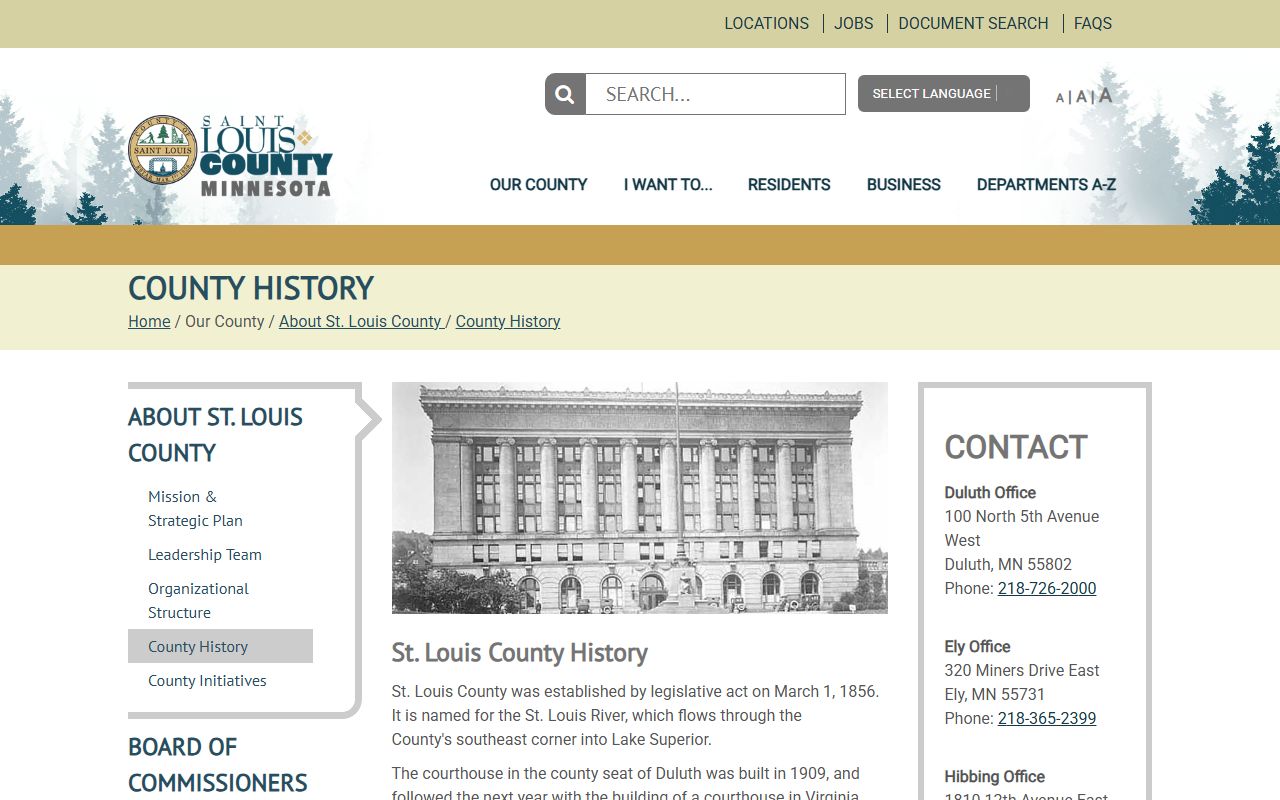
The page emphasizes why confirmation matters and why the publication list is only one stage in a larger court-admin process.
Sheriff, Jail Roster, and Inmate Status
The Sheriff’s Office oversees current custody visibility and public jail rosters for St. Louis County facilities. The roster updates frequently and identifies booking number, age, offense, custody status, and sometimes court action links. People in custody can transfer between facilities for operational reasons, and the roster is not a substitute for certified case records or court orders.
St. Louis County maintains one main jail in Duluth and two 72 hour lockup facilities. For in-court outcomes, use MCRO and court office channels. For custody or transfer questions, use the Sheriff contact routes and verify whether the person is held locally, on transfer, or under another agency flag.
Source link for the Sheriff public information pages:
https://www.stlouiscountymn.gov/departments-a-z/sheriff/jail
Use the roster and jail pages as custody channels, but follow court-file verification for legal status questions and appearance obligations.
Public Access Laws and Limits for St. Louis Court Records
Access and confidentiality for St. Louis County court materials are governed by Minnesota statutes and judicial rules. They define what appears online, what can be inspected at court, and what stays restricted for juvenile, mental health, protected orders, and sealed or expunged records.
Key statutes:
Minn. Stat. ch. 13 - governs government data practices and public/private classifications.
Minnesota Rules of Public Access - sets baseline court-record inspection, copying, and remote-access standards.
Minnesota Rule 4 - explains what categories of case records may be unavailable due to access restrictions.
Minn. Stat. 260B.163 - juvenile proceeding records and confidentiality limits.
The home page of St. Louis County and Minnesota Courts also publish practical filing reminders and links to fee and access pages for filing and copy options. Use the court office when a record is not remotely posted, especially for certified copies, missing documents, or appeal notices.
Specialty Courts and Treatment Programs
St. Louis County supports treatment court pathways inside the Sixth Judicial District, including drug, DWI, veterans, mental health, and recovery court programs. These programs combine court oversight, treatment planning, and periodic review rather than functioning as independent record repositories.
Entries appear in county and district updates, and participants are screened through the justice process. Because rules for diversion and treatment orders vary, use district dockets and the case file for current status.
Marriage, Divorce, and Probate in St. Louis County
Marriage licenses and certificates are part of county public records and recorder workflows, while divorces and probate are trial-court matters inside Minnesota District Court. St. Louis County users therefore use different channels depending on whether a case started as a marriage record, a divorce proceeding, or an estate filing.
Marriage records may be requested from St. Louis County Public Records offices. Divorce records can be searched online through court portals, with certified decrees sourced from the courthouse where the matter was granted. Probate follows the Probate Division model in District Court, and small estates may route to affidavit processes when statutory thresholds are met.
Source link for St. Louis County marriage and probate workflows:
https://www.stlouiscountymn.gov/marriagelicense
The County uses this public-record channel for marriage license and certificate handling, while probate follows court filing practice under District Court procedures.
Court Fees, Filing, and Copy Requests
Most case retrieval work in St. Louis County begins with free online visibility through MCRO and then transitions to office channels for paid certified outputs. The official fees vary by filing type and document type.
| Service Type | Cost | Access Channel |
|---|---|---|
| Case search | No charge | MCRO and hearing/judgment portals |
| Certified records | Court office fee | St. Louis County District Court administration |
| Judgment entry check | Depends on court output | MCRO judgment search |
| Marriage certificate copies | $9 per copy | St. Louis County Public Records |
St. Louis County Court Fee guidance is maintained on the Minnesota court fee schedule and should be confirmed at filing because the amount can change by category and case type.
Source link for fee details:
https://mncourts.gov/help-topics/court-fees/district-court-fees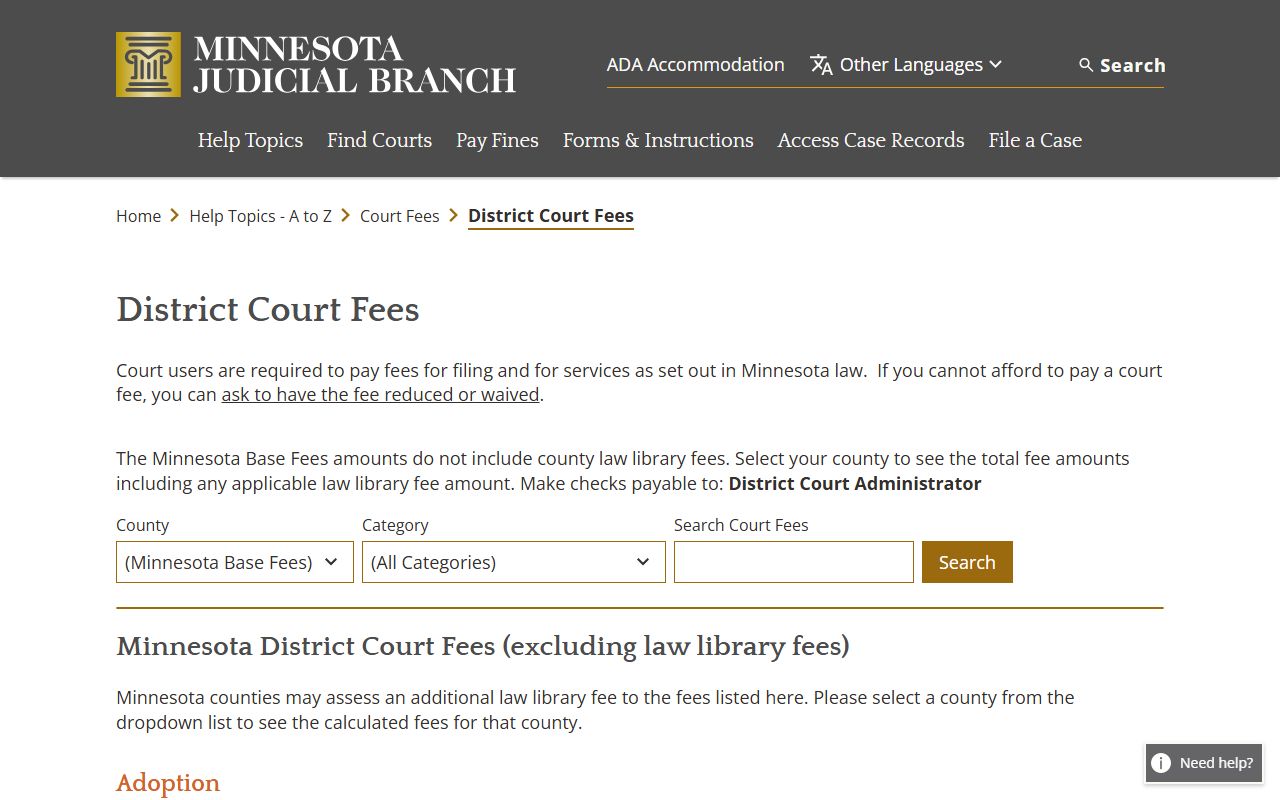
Use the official fee schedule as the baseline and confirm any filing add-ons by office in Duluth, Hibbing, or Virginia.
St. Louis County Court History and Local Context
St. Louis County was organized in 1856 and later served by courthouse infrastructure in Duluth and Virginia because of size, terrain, and settlement pattern. The county has retained three trial-court locations because Duluth and the northern communities are too distant to rely on one office model. The resulting court design explains why records channels are both centralized online and geographically distributed in person.
County history and local records references provide continuity for current users, especially in disputes where location affects filing, in-person review, and service routes.
Source link for historical context:
https://www.stlouiscountymn.gov/our-county/about-st-louis-county/county-history
That local history directly affects practical record access strategy, from physical direction planning to the distribution of clerk services.
Frequently Asked Questions
Can a St. Louis County case be found by defendant name on MCRO?
Usually yes, but only when a case is in a public-access category and the name matches the case indexing format. Pending minor criminal and some traffic records without conviction may still not surface by name. In those cases, users should search by exact case number or case number prefix patterns and then verify in person with court administration.
Where should fees be paid for certified copies?
Certified copies of St. Louis County court documents are requested at the relevant District Court office, not through MCRO, because MCRO is a viewing system. The office contact channel for the location where the case is filed is the standard path for certification and fee confirmation.
How is hearing status confirmed when calendars are unclear?
Courthouse calendars are useful, but St. Louis County notices that calendars are not a complete list of all matters. Court records and local hearing search channels should be used together, and parties should confirm changes through the filing office or courtroom clerk if attendance matters.
Recent St. Louis County Court Activity
Recent county and Minnesota court announcements in 2025 and 2026 include updated case outcomes and public safety updates, reinforcing the practical need to confirm records by case number and date. Notable releases include court updates for cases such as 69VI-CR-25-809, 69DD-CR-25-1689, and 69DU-CR-25-2700, as well as county updates on staffing and public access programs.
Recent traffic ticket warnings from state courts also matter for record users, especially for payment and scam awareness. Use official Minnesota Court Payment links rather than unofficial message links when a citation is payable.
Source link for court activity and county communications:
https://content.govdelivery.com/accounts/MNSTLOUIS/bulletins/402e2e5
Current updates reinforce that case-number validation and office confirmation are essential in a high-volume multi-location district.